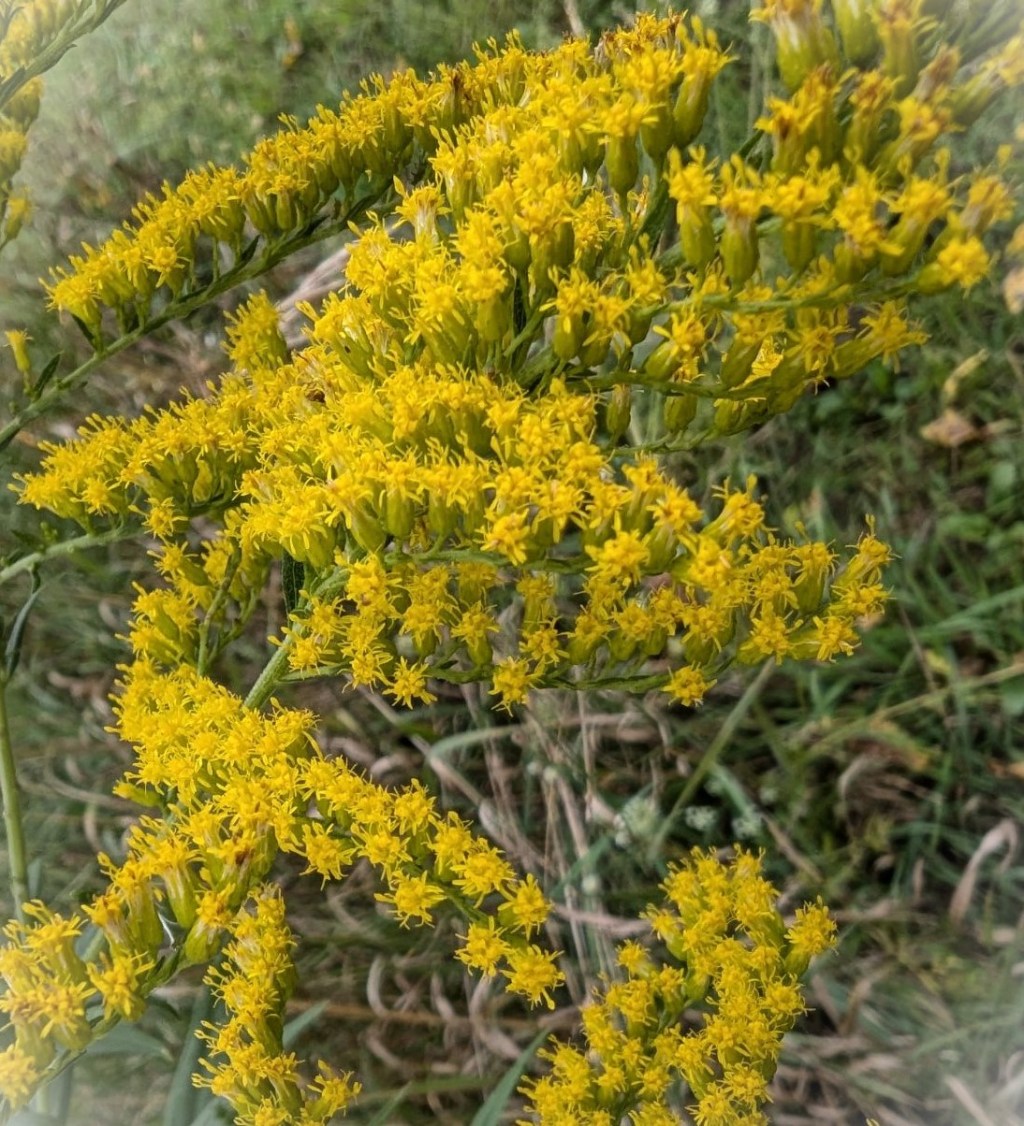
Solidago canadensis
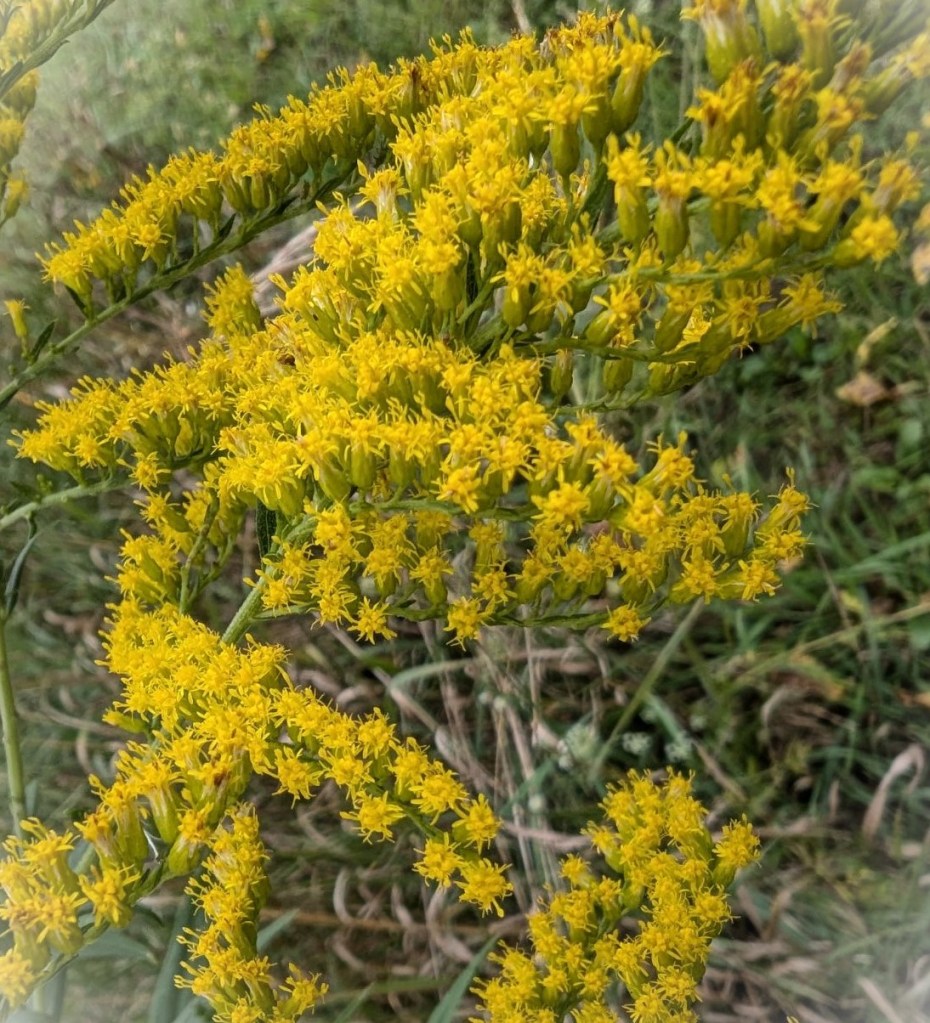
Photo by Suzanne Harrington
Aaah! Aaah! Chooh! That’s what you may be thinking as soon as you saw this picture. Would you be surprised to learn that the majority of allergies that people suffer from at this time of year in our area are NOT caused by this beautiful and abundant plant? Rather, ragweed is generally the culprit as its pollen is dispersed by the wind. Canada Goldenrod has taken the blame from allergy sufferers for many years without due cause. Hopefully after reading this article, you will look upon this beauty as a healer as opposed to a causer of illness.
Historically, Canada Goldenrod, Solidago canadensis, has been used by American Indians for burns, fevers, snakebites, sore throats, kidney ailments, as food, for side pains, as a sedative, diarrhea, skin wounds on horses, and as gambling medicine. Also, Canada Goldenrod was often found in Liberty Tea blends that Colonists made while boycotting imported tea after the Boston Tea Party.
Canada Goldenrod belongs to the Asteraceae family and is native throughout Michigan and most of North America. It can now be found throughout Europe, Asia, South America and Australia. This plant, which also goes by the names goldruthe, woundwort and solidago, grows in dry or wet areas, full or partial sun, open fields, prairies, roadsides, trails, meadows, railroad tracks, dry rocky ground, marshes, floodplains and bordering conifer swamps and forests. This perennial grows 1-5 feet in height and has a fibrous and rhizomatous root system. It has a stem that is smooth at the base and is hairy below the lower flower branches. Leaves are simple and lance-shaped with 3 veins alternately attached with no leaf stem. They are 2-5 inches long and many have sharp teeth but may also be smooth and hairy. Some say the crushed leaves have a salty balsam fragrance or may smell like anise. As far as taste goes, I think it is reminiscent of a plain green tea, but better, with a hint of floral and anise. The beautiful yellow composite flowers are ¼ inch in diameter and arranged in large arching spike clusters that are 3-9 inches long and are raceme or form a triangular panicle with the tip of the largest spike nodding to one side. The flowers bloom July through September and towards the end of summer the flowers will “fluff” making the brown seeds visible. The flowers have what I would describe as a pleasantly familiar taste. It is something that I just can’t put my finger on, maybe asparagus, maybe floral, maybe anise. They really do make a lovely bright yellow cup of tea that is quite enjoyable. Canada Goldenrod reproduces from seeds but mainly from their root system.
Nearly the entire plant is useful in a variety of ways from food and medicine to incense and aesthetically pleasing bouquets and even as a natural dye. As food, the seeds can be used as a survival food or powdered to use as a soup thickener. The flowers go nicely in a salad, can be lightly fried or added to cookies, shortbreads, muffins and pancakes. They also make a nice addition to cordials and can be made into wine or jelly and infused in honey or vinegar. The leaves make a nice cuppa or can be cooked as you would spinach. Health wise, leaves and flowers can be made into tea, extracts, decoctions, poultices, syrups, ointments and salves. The leaves can be powdered to use as a styptic to stop bleeding of small wounds and the flowers can be infused in oil for a muscle rub.
Harvest healthy leaves and flowers that are free of powdery mildew or other disease and bug homes (Goldenrod is especially loved by the Goldenrod Crab Spider and the Goldenrod Gall Fly) after the dew has dried and before the sun is its hottest. Leaves can be harvested through spring and summer before the flowers open and flowers can be collected in late summer or early autumn just as the flowers open. If the flowers have already “puffed” they are still ok to use. Roots can be harvested in early spring or autumn after the first heavy frost. Wash and cut them into small thin pieces and be sure to dehydrate thoroughly. Collect seeds after the flowers have turned brown and dry. If you are not using your goldenrod fresh, be sure to thoroughly dry for long term storage.
My review of the literature found that Canada Goldenrod has a host of chemical compounds that are beneficial for us. It contains essential oil that is laden with monoterpenes and sesquiterpenes, aromatic acids, flavonoids, and triterpenes. Here is my list:
Essential Oil Monoterpenes
- α-pinene
- Limonene
- Bornyl acetate
- β pinene
- Myrcene
- Sabinene
Essential Oil Sesquiterpenes
- Germacrene D
- 6-epi-β-cubebene
- 6-epi-α-cubebene
- Cadinene
- Germacrene A
- α-humulene
- b-caryophyllene
- β-ylangene
Aromatic Acids
- Gallic acid
- Protocatechuic acid
- Vanillin/vanillic acid
- Syringic acid5-O-feruloylquinic acid
- Caffeoyl-di-feruloylquinic acid
- 1-caffeoylquinic acid
- 4-caffeoylquinic acid
- 5-caffeoylquinic acid
- 3,4-O-dicaffeoylquinic acid
- 3,5-O-dicaffeoylquinic acid
- Ferulic acid
- Chlorogenic acid
- Caffeic acid
- Coumaric acid
Flavonoids
- Quercetin
- Rutoside
- Quercitrin
- Isoquercetin
- Rutin
- Hyperoside
- Quercetin-O-hexoside
- Quercetin-(acetyl)-hexoside
- Quercetin-(rhamnosyl)-hexoside
- Quercetin-3-O-(6’-O-acetyl)-β-D-glucopyranoside
- Isorhamnetin 3-O-hexoside-7-O-deoxyhexoside
- Isorhamnetin-(acetyl)-hexoside
- Isorhamnetin-(rhamnosyl)-hexoside
- Isorhamnetin-3-O-β-D-glucopyranoside
- Astragalin
- Kaempferol-(rhamnosyl)-hexoside isomers
- Hesperidin
- Afzelin Kaempferol-3-O-(6’-O-acetylyl)-β-D-glucopyranoside
- Kaempferol-3-O-β-D-apiofuranoside
- Kaempferol-O-hexoside-deoxyhexoside
- Catechins
- Epicatechins
- Hydroxy flavanone
- Anthocyanidins
Triterpenes
- Saponins
Translation of these constituents’ effects in/on our bodies:
- Astringent (constricts tissue)
- Antiseptic
- Anti inflammatory
- Antibacterial
- Antifungal
- Styptic (stops bleeding)
- Antihistamine
- Antiallergenic
- Antioxidant
- Antiphlogistic (against inflammation and fever)
- Antiasthma
- Antimutagenic (preventing mutation of genes)
- AnticancerBitter that stimulates digestive secretions
- Carminative (relieves digestive gas)
- Diuretic
- Diaphoretic (promotes sweating)
- Expectorant
This predominantly warming and stimulating plant may be of assistance when a body is battling congestion caused by allergies (especially ragweed), sinus infections, colds, flu, asthma or other diseases that cause inflammation to the respiratory tract. One might consider Canada Goldenrod for general cardiovascular support, poor circulation and weak capillaries (drinking tea daily), sore throats such as laryngitis and pharyngitis (drink as a tea or let the tea cool and use as a gargle), diarrhea, upset stomach, poor digestion, or other issues that cause an inflamed digestive tract.
The word solidago means to make whole, which makes sense when we see how Canada Goldenrod can help to mend the skin. It may be useful for minor wounds, minor burns (especially the roots of the goldenrod), open sores, minor cuts, boils, skin irritations and minor bleeding wounds (use crushed leaves as a styptic). The flowers and leaves can be used as a poultice or infused into oil and then used as an oil or made into salves. The infused oil used as a rub may also be beneficial for joint pain and swelling and muscle fatigue. The flowers, taken internally as a tea, infused honey, extract, syrup, or eaten can assist with pain and swelling associated with gout and rheumatism. The flowers can also be applied as a poultice or made into a wash and applied to those affected areas as well.
One of the areas where Canada Goldenrod shines is the urinary system. It is even an approved herbal medicine in Germany for treating kidney stones. Leaf extract can aid with spasming and inflammation of the urinary tract. Also, it works as a diuretic helping the kidneys to remove excess fluid. The leaves and/or flowers aid in recovery from urinary tract infections, stones and gravel and as a general kidney tonic after long bouts of illness. To me, one of the best uses of Canada Goldenrod is for combatting cat and seasonal allergies, especially ragweed allergies which Goldenrod is so often blamed for. Extracts are very useful when it comes to allergies, colds (especially with a fever) and pink eye with a general dose of 2-4mL three times daily. For Candida yeast infections, a tea or decoction taken daily or a powder can be applied externally. Make a gargle for oral thrush. Canada Goldenrod has shown antibacterial activity against Listeria monocytogenes, Escherichia coli, Staphylococcus aureus, Salmonella sp., Staphylococcus faecalis, Bacillus subtilis, Klebsiella pneumoniae, and Psudomonas aeruginosa. It has also shown promising activity against Salmonella typhi perhaps even surpassing ciprofloxacin.
Canada Goldenrod is being studied for cytotoxic activity against lung cancer, colon cancer, and normal fibroblasts.
As always, just because something is natural does not mean it is without safety concerns. With Canada Goldenrod, please be aware that it may cause an allergic reaction, it is ok for long term use for chronic conditions but you should monitor for dehydration due to the diuretic effects. Please do not use while pregnant or nursing unless first consulting a qualified practitioner. Speak with your primary care provider before routine use of Canada Goldenrod if you have chronic kidney disorders. And lastly, for a small percentage of people, it can raise blood pressure so caution should be used with extra blood pressure monitoring for those with hypertension.
If you are using Canada Goldenrod as a supplement to your health, you should consult with your primary care provider because nothing in this article has been approved by the FDA. The above information is not intended to diagnose, treat, or cure any diseases, it is for informational purposes only.
To make a lovely cup of tea, add 1 tablespoon of fresh flowers and/or leaves (2 teaspoons if dried) to 2 cups of boiling water. Steep for 15 minutes then strain. You can add an equal amount of mint to change the flavor if desired. Drink up to 3 cups per day.
I hope you enjoyed reading this article and will now look at Canada Goldenrod as a hero when it comes to allergies as opposed to the culprit. We have available for purchase at Amy’s Relation to Creation and Botanicals, LLC dried Canada Goldenrod Leaves and Flowers. Stop in and try some today! Happy harvesting!
References:
Apelian, Nicole and Davis, Claude. The Lost Book of Herbal Remedies: The Healing Power of Plant Medicine. Global Brother SRL. 2019.
BRIT – Native American Ethnobotany Database naeb.brit.org/uses/search/?string=solidago. Accessed 08/29/2024.
Foster, Steven and Duke, James. Peterson Field Guides: Eastern/Central Medicinal Plants and Herbs. Second ed. Houghton Mifflin Company. 2000.
Fursenco, C., Calalb, T., Uncu, L., Dinu, M., & Ancuceanu, R. (2020). Solidago virgaurea L.: A Review of Its Ethnomedicinal Uses, Phytochemistry, and Pharmacological Activities. Biomolecules, 10(12), 1619. https://doi.org/10.3390/biom10121619
Goldenrod (herbalgram.org). https://www.herbalgram.org/resources/commission-e-monographs/monograph-approved-herbs/goldenrod. Accessed 08/29/2024.
Herbal Academy Contributors. (2019, August 2). 4 of the Best Herbs For Pink Eye. In The Herbal Academy Blog. Retrieved 14:49, September 5, 2024, from https://theherbalacademy.com/blog/best-herbs-pink-eye/
Jacob Bigelow’s American Medical Botany: Digital Reissue Illuminates Access to Rare Work (herbalgram.org). https://www.herbalgram.org/resources/herbalgram/issues/63/table-of-contents/article2720/. Accessed 08/29/2024.
Johnson, Jackie. (2017, September 26). 3 Tips for Foraging Goldenrod This Year. In The Herbal Academy Blog. Retrieved 14:45, September 5, 2024, from https://theherbalacademy.com/blog/foraging-goldenrod/
Michigan Flora michiganflora.net/record/454. Accessed 08/29/2024.
Onacki, Donna. (2014, September 3). Health Benefits of Goldenrod (+ Tea Recipe). In The Herbal Academy Blog. Retrieved 15:15, September 5, 2024, from https://theherbalacademy.com/blog/health-benefits-of-goldenrod/
Pivarnik, Meghan. (2019, August 29). 3 Late-Summer Herbs and How to Use Them: New England Aster, Chrysanthemum, and Goldenrod. In The Herbal Academy Blog. Retrieved 13:36, September 5, 2024, from https://theherbalacademy.com/blog/late-summer-herbs/
Poljuha, D., Sladonja, B., Uzelac Božac, M., Šola, I., Damijanić, D., & Weber, T. (2024). The Invasive Alien Plant Solidago canadensis: Phytochemical Composition, Ecosystem Service Potential, and Application in Bioeconomy. Plants (Basel, Switzerland), 13(13), 1745. https://doi.org/10.3390/plants13131745
Richardson, Bruce. Liberty Teas of Colonial Boston. In The Tea Master’s Blog. Retrieved 14:28, September 5, 2024, from https://www.bostonteapartyship.com/tea-blog/liberty-teas-of-colonial-boston
Tekiela, Stan. Wildflowers of Michigan Field Guide Adventure Publications, 2000.
USDA Plants Database plants.usda.gov/home/plantProfile?symbol=SOCA6. Accessed 08/29/2024.
Wikipedia contributors. (2024, August 28). Saponin. In Wikipedia, The Free Encyclopedia. Retrieved 22:58, August 29, 2024, from https://en.wikipedia.org/w/index.php?title=Saponin&oldid=1242792025

 Amy's Relation to Creation & Botanicals, LLC
Leave a reply to Ashley Cuevas Cancel reply