Roses are red,
Violets are blue,
Sugar is sweet,
So are you!
I’d imagine this poem that speaks of Violets is one of the very first poems that I memorized as a child, perhaps you did too! This little flower is so often overlooked not only for its beauty, but also for its culinary and supportive health benefits. I vividly remember in junior high going with my friend’s mother to a huge patch of violets and each of us picking bowls full of the delicate flowers. We then went back to their home and I watched her make a batch of beautiful jelly! I think I can still imagine the delicate taste all these years later. Please join me as we take a little journey learning about this petite plant that is native to our magnificent Michigan!
One of the early spring bloomers, the Common Blue Violet, Viola sororia, has been talked and written about for a very long time. In fact, in Greek mythology and the story about one of Jupiter’s lovers, Io, the violet flower was created so that Io could have something to eat after she was turned into a heifer. Violets have been used to support health at least since the Athenians who used the plant to moderate anger, as a sleep aid, and to comfort the heart. They were also mentioned in the writings of Virgil, Homer, Pliny, Apuleius, Macer, Gerard, Askham and Shakespeare. Closer to home, Cherokee people have used violets as an analgesic, antidiarrheal, blood medicine, cold remedy, cough medicine, skin healer, respiratory aid, a general tonic and an insecticide.
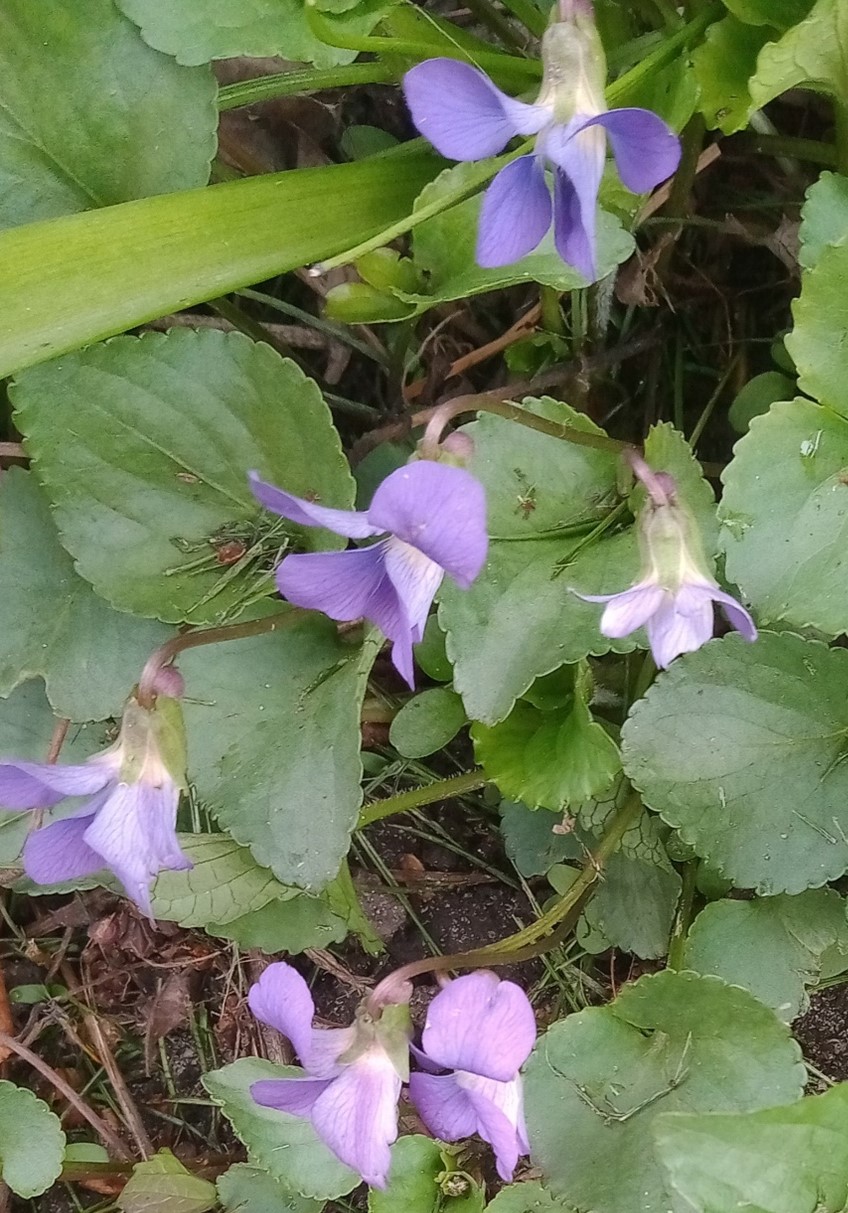
The Common Blue Violet belongs to the Violaceae family and can be found from North Dakota to Quebec to Maine. This dainty flower prefers shade but will grow in sunny areas as well. You can usually find this plant growing in clumps in woods, thickets, and stream banks. The Common Blue Violet is a perennial that reaches 4 to 6 inches tall and blooms from early spring to early summer with flowers that are deep violet to lavender or white that darkens towards the throat with a white center and are about 1 inch in diameter. Flowers have 5 petals of unequal size with the lower petal being longer. The lower and lateral petals are strongly veined. Flowers are at the end of a leafless stalk. Heart shaped basal leaves grow from the underground root, are scallop toothed, woolly and rolled along the edges. The leaf stalks are longer than flower stalks and are woolly. A seedpod is produced which has many tiny brown seeds that are sometimes distributed by ants for reproduction, however, violets mostly reproduce by underground runners.
Leaves and flowers are both edible with leaves having a mildly bitter taste and sticky texture and flowers having a mild taste with a touch of sweetness. In addition to culinary uses, the Common Blue Violet can be used in wines, juices and teas, made into tinctures, washes, poultices, salves, and syrups and infused in oils and vinegars. Leaves and flowers can be harvested daily April through June when flowers are freshly opening. Harvest in the morning and dry whatever is not used fresh.
When it comes to the constituents found in the Common Blue Violet, it has a rather simple profile. Found within the plants leaves and flowers are vitamins A and C, minerals calcium and magnesium, the alkaloid violine whose precise action is unknown at this time, the aromatic acid salicylic acid, and the quercetin flavonoids rutin and viola-quercitin.
These constituents lead the Common Blue Violet to be a cooling and moistening plant that supports the body by acting as a detoxifier, immune booster, a stimulant for the lymphatic system, pain reliever, blood cleanser, mucilaginic, anti-inflammatory, antiseptic, laxative, and anxiolytic. Specifically, this plant helps the body when dealing with:
inflammation in the lungs
irritated bronchial passages
stuck mucous
sore throats
colds and sinus infections
lung cancer
joint pain, especially in the back and neck
joint inflammation
grief, depression and anger
high cholesterol
thick blood
varicose veins
lymphatic congestion with swollen glands
constipation
imbalanced intestinal flora
minor scrapes and bruises
eczema
rashes
insect bites
skin cancer
growths, cysts, and lumps in the breast
breast cancer
As always, consult with your primary care provider for any of the above conditions. Also, please be sure that you are harvesting the correct plant because there can be poisonous look-a-likes. Some people may develop contact dermatitis with this plant so use caution when handling for the first time. Do not eat roots or seeds as large doses can cause severe stomach upset, vomiting, high blood pressure and difficulty breathing.
So, how do you use this plant? Well, the fresh young leaves and flowers make a beautiful addition to a salad or as a garnish for cakes and pastries, older leaves can be used in soups or stews and act as a thickening agent. One can also make wine with the flowers or a beautiful jelly. Violet leaf juice can be made with a large handful of clean, new leaves and 1 cup of water mixed in a blender until leaves are completely macerated. A hot tea is made with 1 part flowers to 2 parts leaves (fresh or dried) with 1 cup of hot, near boiling water steeped for 5 minutes and then strained. Honey can be added to taste. Make an infusion with cold water steeping for at least 3 hours to extract mucilage. Make a poultice by grinding leaves and flowers with a little water into a paste and apply to painful joints, minor wounds, varicose veins or hemorrhoids. These are just a few ways to use the Common Blue Violet. Here is a recipe from Taste of Home for violet jelly.
As always, if using the Common Blue Violet as a supplement to your health, you should consult with your primary care provider because nothing in this article has been approved by the FDA. The above information is not intended to diagnose, treat, or cure any diseases, it is for informational purposes only.
I hope that you enjoyed learning a bit about the Common Blue Violet and that when spring comes again you will remember this article and try your hand at using this beautiful little plant in your kitchen. While I do not currently have dried violets here in the store to sell, please stop in if you would like to have a further discussion about them. Amy’s Relation to Creation & Botanicals, LLC in Marine City, MI is a place where you can find natural products for everyday life including over 100 dried herbs, teas, salves and balms, oral hygiene products, bathing products, books to further your knowledge, essential oils, extracts and much more. About half of our products are locally sourced as well. We also hold a very relaxed Bible study on Sundays at 9am that we would love to see you at!
Peace be with you,
Amy
References:
A Modern Herbal | Violet, Sweet (botanical.com) botanical.com/botanical/mgmh/v/vioswe12.html. accessed 5/14/2024.
BRIT – Native American Ethnobotany Database. Naeb.brit.org/uses/search/?string+viola+sororia. Accessed 5/11/2024.
Creating a Local Materia Medica with Violet – Herbal Academy (theherbalacademy.com) theherbalacademy.com/blog/creating-a-local-materia-medica-with-violet/ accessed 5/14/2024.
Nicole Apelian and Claude Davis. The Lost Book of Herbal Remedies: The Healing Power of Plant Medicine. Global Brother SRL. 2019.
Roger Peterson and Margaret Mckenny. A Field Guide to Wildflowers of Northeastern and North-Central North America. Houghton Mifflin Company. 1968.
Stan Tekiela, and Stan Tekiela|AUTHOR. Wildflowers of Michigan Field Guide Adventure Publications, 2000.
Violet Herb (herbalremediesadvice.org) herbalremediesadvice.org/violet-herb.html. Accessed 5/14/2024.


Leave a comment